
Third-Country Deportations: How the U.S. Sends People to Countries They’ve Never Known
People with no ties to a foreign country are being flown there and held without charges. Here is what the practice is, how it grew, and the due-process questions courts are now weighing.

What third-country deportation is
Most deportations send a person back to the country they came from. Third-country deportation does something different: it sends a person to a country they have no connection to — no citizenship, no family, no language, sometimes a place they have never set foot in.
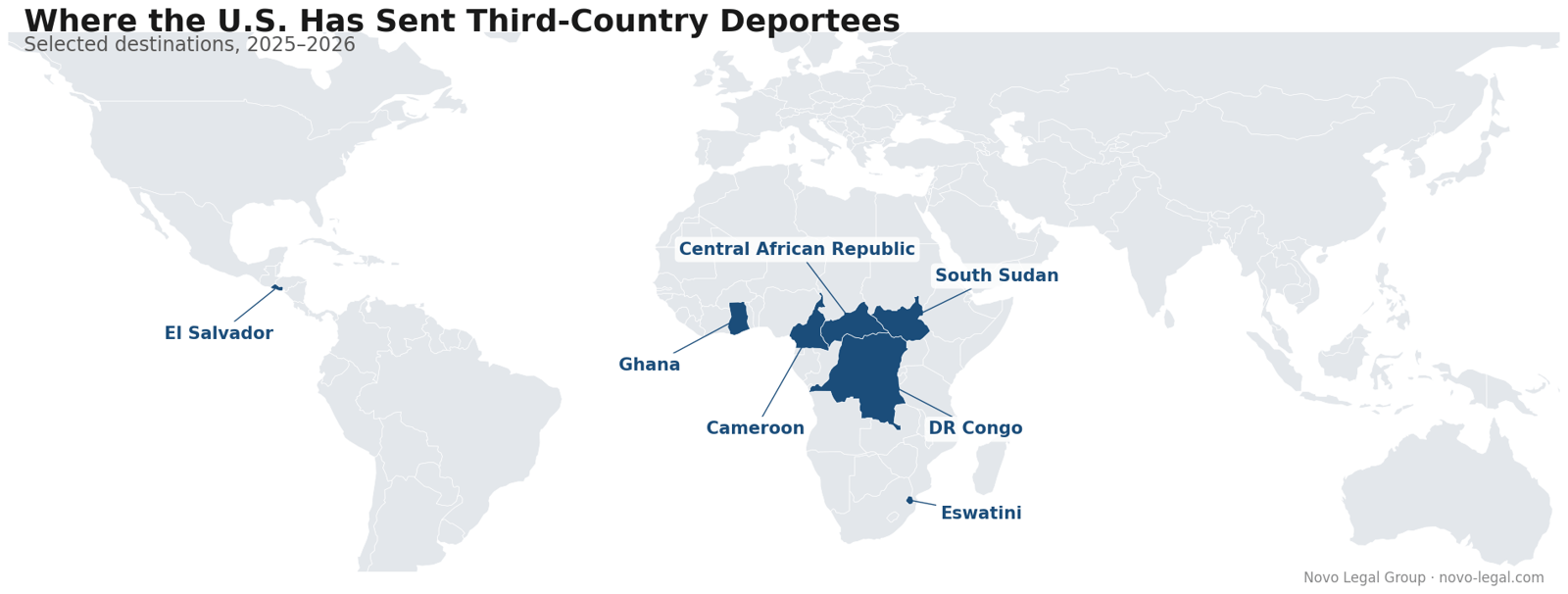
The practice is used when a person’s home country refuses to take them back, or when a court order bars their return home. Historically it was rare. In the current administration it has expanded sharply. At least 35 countries have made agreements to receive people the United States wants to remove.
The people sent this way usually have no legal status in the receiving country. Many are held in detention indefinitely, without charges, with no clear path out. That combination — removal to a place a person has no tie to, followed by open-ended detention — is what sets third-country removal apart from a standard deportation.
This page is a reference guide. Below: how the practice grew through 2025 and 2026, the legal framework courts are applying, and the litigation now underway.
Scale and timeline, 2025–2026
The pace and reach of these removals grew through 2025 and into 2026. The verified sequence below is drawn from court records, wire reporting, and firm press releases (see Sources).
- March 2025 — El Salvador. El Salvador accepted roughly $6 million to hold about 250 Venezuelan men at CECOT, the country’s mega-prison. The men were later flown home; many alleged abuse in detention.
- July 2025 — Eswatini, first group. Five men — nationals of Cuba, Jamaica, Laos, Yemen, and Vietnam — were flown to the Kingdom of Eswatini in southern Africa and held at the Matsapha Correctional Complex. Eswatini received $5.1 million in connection with the arrangement.
- September 2, 2025. Reporting confirmed that deported men were being held in an African prison despite having already completed their U.S. sentences, and that they had been denied access to lawyers.
- September 2025 — a first exit. Orville Etoria, a Jamaican national, was repatriated — one of only two men to leave Eswatini detention at that point.
- October 6, 2025. Ten more men were deported to Eswatini.
- October 2025 — hunger strike. Roberto Mosquera, a Cuban national, began a hunger strike that lasted about a month, protesting that he was being held with no counsel and no charges.
- Fall 2025 — Ghana and Cameroon. Deportation flights to Ghana and Cameroon began. Some of the people sent were reportedly under court protection orders or protected under the Convention Against Torture.
- February 2026 — Cameroon. More third-country nationals were deported to Cameroon.
- April 17, 2026 — Congo (DRC). About 15 Latin American people were deported to the Democratic Republic of the Congo, believed to be under U.S. court protection orders.
- June 2026 — Central African Republic. A deportation flight landed in the Central African Republic.
- July 8, 2026 — Eswatini, third group. Eleven more deportees arrived in Eswatini.
- August 12, 2026. A New York Times Magazine feature reported 19 men held in Eswatini and six to seven in South Sudan in long-term detention. The Department of Homeland Security’s written statement claimed the removals followed due process; the government of Eswatini was non-responsive to the reporter.

The legal framework
Third-country removal sits on top of a body of law built to prevent exactly the harm these cases describe. A few concepts do most of the work.
Non-refoulement and the Convention Against Torture
The Convention Against Torture bars the United States from returning a person to a country where they are likely to face torture. That protection can be undone indirectly. Chain refoulement is the term for deporting someone who has protection against being sent home to a third country that then forwards them home anyway. Sending a person to the third country can accomplish what the law forbids doing directly. Chain refoulement is banned under the Convention Against Torture.
Limits on indefinite detention
In Zadvydas v. Davis (2001), the Supreme Court held that immigration detention after a removal order cannot continue indefinitely when there is no significant likelihood of removal in the reasonably foreseeable future; the Court treated roughly six months as a presumptively reasonable period of detention. The rule matters here because indefinite detention — at home or abroad — is one of the central features of these third-country cases.
Rights in a third-country removal
Several protections generally apply when the government proposes to send someone to a third country. In general, a person may be able to contest the designation of the third country, seek protection under the Convention Against Torture, seek withholding of removal, request a hearing before an immigration judge, invoke consular notification, and pursue emergency stays. Whether any of these applies in a given situation depends on the facts, and people in this position typically work with counsel to raise them.
A recurring theme in the current wave of cases is timing: multiple federal lawsuits are ongoing over removals that were carried out before the people involved could see a judge.
The Eswatini docket
What happened
Beginning in July 2025, groups of men were flown from the United States to Eswatini and held at the Matsapha Correctional Complex. Several had already completed their U.S. sentences. For roughly nine months, the men were held without being allowed to meet with lawyers.
The hunger strike
In October 2025, Roberto Mosquera began a hunger strike lasting about a month, protesting detention with no counsel and no charges. Wire services reported his account, and one described the arrangement in terms a source likened to human trafficking.
The African Commission complaint
In December 2025, Novo Legal Group — with the Global Strategic Litigation Council and Cornell Law School’s Transnational Disputes Clinic — filed the first complaint with the African Commission on Human and Peoples’ Rights over the Eswatini detention, on behalf of three deported men. In March 2026, the African Commission agreed to hear the case.
The access-to-counsel ruling
On April 10, 2026, after roughly nine months of litigation, the Supreme Court of Eswatini ruled that the deported men are entitled to meet with counsel. The firm worked with local counsel in Eswatini on the case.
The current picture
As of August 2026, reporting placed 19 men in long-term detention in Eswatini and six to seven in South Sudan. These are active matters; this page reports only what has been publicly reported and takes no position on case strategy or outcome.
Due-process questions courts are weighing
Several questions run through the litigation:
- Can the government remove someone before they see a judge? Multiple federal suits challenge removals carried out before the people involved could be heard in court.
- Does sending a person to a third country evade protections against return home? This is the chain-refoulement question — whether a third-country transfer accomplishes indirectly what non-refoulement forbids directly.
- How long can a person be detained abroad without charges? The Eswatini and South Sudan cases involve open-ended detention of people who, in several instances, had already completed their U.S. sentences.
- Do people removed this way have access to counsel? The Eswatini Supreme Court answered yes in that jurisdiction in April 2026, after nine months in which the men had no such access.
These are the questions in front of the courts. How they are resolved will shape whether third-country removal continues at its current scale.
Novo Legal Group’s role
Alma David, Of Counsel at Novo Legal Group, is the U.S. lawyer for Roberto Mosquera and several other men detained in Eswatini. She leads the firm’s work on this docket. In the New York Times Magazine feature, she is credited as a source for the reporting and describes the situation the detained men face — a “legal black hole,” and people “disappearing into this no man’s land.”
Together with the Global Strategic Litigation Council and Cornell Law School’s Transnational Disputes Clinic, the firm filed the December 2025 complaint with the African Commission on Human and Peoples’ Rights on behalf of three of the deported men; the Commission agreed to hear the case in March 2026. The firm also worked with local counsel in Eswatini on the access-to-counsel case that produced the April 2026 Supreme Court ruling.
The work has been covered by the New York Times Magazine, the Associated Press, Reuters, Agence France-Presse, CBS News, Telemundo, and New Lines Magazine. A fuller press record is maintained on Alma David’s bio page.
This is a reference resource, not a solicitation. For the firm’s broader immigration work, see the deportation defense practice page.
Frequently asked questions
What is a third-country deportation?
It is a removal that sends a person to a country they have no connection to — not their home country and, in many cases, a place they have never been. It is generally used when a person’s home country will not take them back or when a court order bars their return home.
Why are people being sent to countries like Eswatini?
The United States has made agreements with a number of countries to receive people it wants to remove. Reporting indicates at least 35 countries have entered such agreements, and that money has changed hands in some — Eswatini received $5.1 million in connection with its arrangement.
Is third-country deportation legal?
The government asserts these removals follow the law. Whether a specific removal is lawful is being litigated in multiple federal cases, particularly where people were removed before they could see a judge, or where a transfer risks returning a person to a country they had protection against. Courts have not settled these questions.
What is chain refoulement?
It is deporting a person who has protection against being returned to their home country to a third country that then sends them home anyway. It is a way of accomplishing indirectly what the law forbids directly, and it is banned under the Convention Against Torture.
What rights does a person generally have when facing removal to a third country?
In general, protections may include contesting the designation of the third country, seeking protection under the Convention Against Torture, seeking withholding of removal, requesting a hearing before an immigration judge, consular notification, and emergency stays. Whether any applies depends on the facts, and people in this position typically raise these issues with counsel.
What has happened in the Eswatini cases so far?
Men were held for roughly nine months without lawyer access. Novo Legal Group, with the Global Strategic Litigation Council and Cornell Law School’s Transnational Disputes Clinic, filed a complaint with the African Commission on Human and Peoples’ Rights in December 2025, which the Commission agreed to hear in March 2026. In April 2026, the Supreme Court of Eswatini ruled the men are entitled to meet with counsel. Several men remain in long-term detention.
Related reading
- New York Times Magazine feature on third-country deportations
- Alma David — Of Counsel
- Deportation defense practice
Sources
- New York Times Magazine, Nicholas Casey (Aug. 12, 2026)
- PBS NewsHour / AP, "3 deported by U.S. held in African prison despite completing sentences" (Sept. 2, 2025)
- PBS NewsHour / AP, "A Cuban man deported by the U.S. to Africa is on a hunger strike"
- CBS News, hunger strike (Roberto Mosquera del Peral)
- Arab News / AFP, "Like Human Trafficking"
- Global Strategic Litigation Council announcement (African Commission green light)
- New Lines Magazine (Dec. 10, 2025)
- AP, "More third-country nationals deported to Cameroon" (Feb. 2026)
- Washington Post / AP, Eswatini Supreme Court ruling (Apr. 10, 2026)
- Courthouse News / AFP, "Eswatini top court rules US deportees entitled to lawyer access"
- Telemundo (ES)
- PBS NewsHour, "About 15 Latin American people deported to Congo by the U.S." (Apr. 17, 2026)
- Reuters via WTVB, "Eleven more Trump deportees arrive in Eswatini" (Jul. 8, 2026)
- Novo Legal Group press release, Sept. 23, 2025 (Etoria)
- Novo Legal Group press release, Oct. 6, 2025 (10 more men)
Press inquiries
Members of the press may contact Aaron Elinoff, Managing Partner, at aaron@novo-legal.com.