
ICE Just Hit 50,000 Arrests in August: What Families Should Know
Luis Cortes Romero · Partner, Novo Legal Group · California Bar · Immigration Litigation & Constitutional Law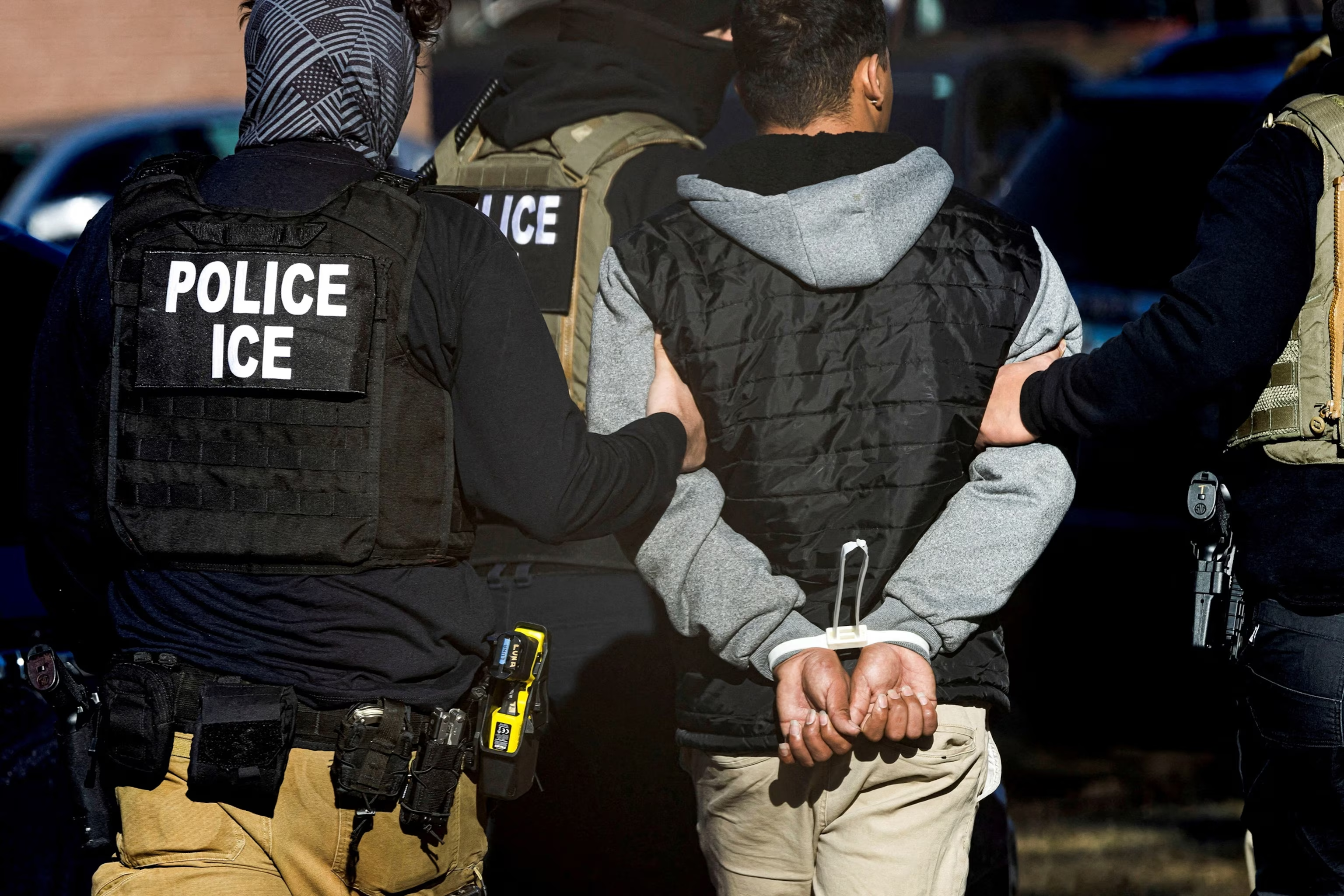
U.S. Immigration and Customs Enforcement arrested roughly 50,000 people in August 2026, according to preliminary data disclosed by a senior Department of Homeland Security official. The August figure is on par with July's 49,571 arrests, which was the highest single-month total in the second Trump administration. It follows June's 43,021 arrests, which set the previous record. August is the third straight month at or near record enforcement levels.
For immigrant families, the practical meaning of these numbers is more important than the numbers themselves. ICE is now averaging about 1,600 arrests per day. That pace has held steady since May, when arrests began climbing after a low of 29,241 in February. In seven months, the daily rate has roughly doubled. The enforcement itself has become less visible in American cities than it was earlier in the year, when high-profile raids drew widespread public attention, but the pace has not slowed. The strategy has changed. The pace has not.
This post explains what the current numbers actually mean in context, why the pace has proven sustainable, and, most importantly, what immigrant families and their advocates should do to prepare. If you have an immigration attorney, this is a good time to check in. If you do not, this is a good time to find one.
Three facts, fast
- ICE arrested approximately 50,000 people in August 2026, on par with July's record of 49,571 and following June's record of 43,021.
- The current pace, about 1,600 arrests per day, is roughly 70 percent higher than February 2026 and is sustained by a $70 billion funding package Congress passed in June that made ICE the wealthiest law enforcement agency in American history.
- Enforcement has shifted from high-profile city operations to less visible interior arrests. The overall pace has held for three straight months and shows no signs of slowing.
Need to prepare a family plan? Contact Novo Legal at (888) 746-5245 or novo-legal.com/en/contact for a case-specific screen.
The August number in context
The 50,000 August figure is a preliminary estimate from a senior DHS official. It has not been formally released by ICE. If confirmed, it would be on par with July's officially released total of 49,571, which was reported through data provided to the Deportation Data Project at the University of California, Berkeley.
Some historical context matters. In fiscal year 2024, under the Biden administration, ICE Enforcement and Removal Operations arrested approximately 113,000 people over the entire year. Under the current pace, ICE is arresting roughly that many people every 70 days. The prior single-month peaks in ICE's history, during periods of aggressive enforcement in earlier administrations, hit around 16,000 monthly arrests. The current monthly rate is roughly three times that historical peak.
Arrests fell sharply in February and March 2026 following the shooting deaths of two American citizens by federal agents during Operation Metro Surge in Minneapolis. That operation, and the political fallout that followed, ended the tenure of Homeland Security Secretary Kristi Noem. Since Markwayne Mullin took over as DHS Secretary in March, enforcement has been steadier, less confrontational in style, and higher in overall volume.
The three-month record streak
The month-over-month progression tells the fuller story:
- February 2026: 29,241 arrests. The post-Minneapolis low.
- May 2026: Arrests began rising.
- June 2026: 43,021 arrests. New record for the Trump administration.
- July 2026: 49,571 arrests. New record, a 15 percent jump from June.
- August 2026: approximately 50,000 arrests. Holding at record pace.
The trajectory from February to August represents an approximately 70 percent increase in monthly enforcement volume. The 1,600 arrests per day pace, if it holds, would produce roughly 585,000 arrests in a full year. For comparison, that would be more than five times ICE's fiscal year 2024 total.
The $70 billion that made this possible
In June 2026, the Republican-controlled House narrowly passed a tax and spending package that included approximately $70 billion for ICE and the U.S. Border Patrol through the end of President Trump's term. The legislation made ICE the wealthiest law enforcement agency in American history.
The funding has been directed toward several concrete uses:
- New "turnkey" detention facilities. ICE has moved quickly to acquire immediately usable detention capacity, including facilities operated by private prison companies such as CoreCivic. The Prairie Correctional Facility in Appleton, Minnesota, which can hold up to 1,600 detainees, is one recent example.
- Additional enforcement tools. Reporting indicates the funding has been used to acquire a range of new enforcement equipment, including some tools that have drawn public attention.
- Personnel and operations. The sustained arrest pace requires sustained staffing and infrastructure. The funding provides both.
The scale of the resources changes what is possible. A department with $70 billion can absorb the political cost of controversy in individual cases and continue enforcement at scale. It can also purchase detention capacity that allows it to hold more people for longer, which affects everything downstream, from bond hearings to removal proceedings to deportation.
The strategy has shifted, the pace has not
Early in 2026, high-visibility operations in American cities drew widespread media attention and public backlash. Operation Metro Surge in Minneapolis was the most prominent example, and its consequences ended one Cabinet Secretary's tenure.
Since March, the visible profile of enforcement has been lower. There are fewer televised raids. There is less high-profile media coverage. There is no single visible campaign the public can point to. That change in visibility has been mistaken by some observers for a change in intensity. It is not.
The arrest data is clear. The pace has held for three consecutive months at levels higher than the earlier confrontational period. Enforcement is happening. It is simply happening in ways that draw less attention.
Reporting from multiple outlets indicates that arrests are increasingly occurring at:
- Immigration court hearings. ICE has increased arrests of individuals appearing at their own removal proceedings.
- Traffic stops and workplace encounters. Local law enforcement cooperation with ICE has expanded in many jurisdictions.
- Airports and transportation hubs. As the recent detention of Milo Yiannopoulos in Louisiana illustrates, airport enforcement remains a regular practice, though the vast majority of airport arrests involve people with no public profile.
- Sensitive locations that were previously protected. Enforcement priorities under the Trump administration have narrowed the categories of locations where ICE will not conduct arrests.
For families, the practical implication is that ICE encounters can now occur in more places, at more times, with less warning.
What immigrant families should do to prepare
Preparation matters. The first 24 to 48 hours after an ICE encounter often shape the outcome of the entire case. Families who have a plan in place before an encounter occurs are in a materially better position than families who begin planning after a family member has been detained.
Have an immigration attorney identified before you need one.
The single most important preparation step is knowing who to call. An initial consultation with an immigration attorney establishes the relationship, allows the attorney to understand your family's specific circumstances, and creates a point of contact for an emergency. Many firms offer initial consultations at reduced or no cost.
Assemble a documentation package.
Every adult family member should have copies of the following available and known to a trusted person outside the household:
- Any immigration documents (green card, work permit, visa, I-94, notice to appear, any USCIS receipt notices).
- Birth certificates, marriage certificates, and other family documentation.
- Documentation of long-term U.S. residence (utility bills, tax returns, employment records, medical records).
- Documentation of any pending immigration application.
- Any documentation of ties to the community (children's school records, church membership, community organization involvement).
- Contact information for family members and an attorney.
Make a family emergency plan.
Every family should know:
- Who takes care of the children if a parent is detained. Have written authorization on file.
- Who has power of attorney to handle finances if you are detained.
- Where important documents are stored.
- What each family member should do in the first hours after an ICE encounter.
Understand your rights during an ICE encounter.
The following rights apply to everyone in the United States, regardless of immigration status:
- You have the right to remain silent. You are not required to answer questions about your immigration status.
- You have the right to refuse to open your door unless ICE presents a warrant signed by a judge. An administrative warrant issued by ICE is not the same as a judicial warrant.
- You have the right to speak to a lawyer before signing anything.
- You have the right to refuse to sign any document you do not understand.
What to do if a family member is arrested by ICE
The steps that matter most in the first 24 to 48 hours are consistent across circumstances:
Locate them. ICE maintains an online detainee locator at locator.ice.gov. It is searchable by A-number (nine-digit alien registration number) or by name and country of birth. If the person does not appear within a few hours, keep trying. It can take time for a new detainee to be entered into the system.
Retain counsel immediately. Immigration detention proceedings move quickly. The first master calendar hearing can occur within days. An attorney who understands the specific circuit's rules on bond, mandatory detention, and habeas relief can make a meaningful difference in the outcome.
Preserve documentation. Gather the documentation package described above and provide it to counsel.
Understand the circuit. The federal circuit in which detention occurs affects what relief is available. If the detention is in Colorado, Washington, or another state within the Ninth or Tenth Circuits, bond hearings are required. If the detention is in Louisiana, Texas, or a state within the Fifth or Eighth Circuits, the current appellate rule is unfavorable to detainees seeking bond. Our companion post from yesterday, "Third Circuit Just Blocked Trump's Mandatory ICE Detention Policy," walks through the circuit-by-circuit landscape.
Document everything. If you witnessed the arrest, write down what happened as soon as possible: time, location, number of officers, any statements made, whether officers presented any documents, whether a warrant was shown. This information can be critical to any subsequent challenge to the detention.
What we don't know yet
The August figure is preliminary. The formal release of ICE data typically occurs a few weeks after month-end through the Deportation Data Project. That release may adjust the figure up or down.
The trajectory for the remainder of 2026 depends on several factors we cannot yet predict:
- Whether the Supreme Court takes up the mandatory detention question this fall.
- Whether Congress modifies immigration enforcement funding.
- Whether the strategy of less visible enforcement continues to hold politically.
- How the current arrest pace interacts with detention capacity, immigration court backlogs, and removal timelines.
We will publish updates as material developments occur.
Frequently asked questions
Are all of these arrests of people who entered without inspection?
No. ICE arrests include people in a wide variety of immigration postures, including lawful permanent residents accused of certain criminal offenses, people whose visas have expired, people whose status has been revoked, and people with pending immigration applications who are alleged to have violated conditions. Detained by ICE does not automatically mean undocumented.
Where are most of the arrests happening?
Arrests are occurring across the country. Reporting indicates increased enforcement at immigration court hearings, at workplaces, at airports, at traffic stops, and in home encounters. There is no single geographic concentration.
Do the arrest numbers include people already in detention?
The 50,000 figure refers to new arrests during August 2026. It does not include people who were already in ICE custody at the start of the month.
What is Operation Metro Surge?
Operation Metro Surge was a series of high-profile enforcement operations conducted in Minneapolis and other American cities earlier in 2026. Two American citizens were shot and killed by federal agents during the operations, which led to the departure of Homeland Security Secretary Kristi Noem in March.
Does my family qualify for any protections?
Whether specific protections apply depends on the individual's immigration status, family situation, criminal history, and country of origin. This is exactly the kind of question that requires an individualized consultation with an immigration attorney.
Should I carry my green card or work permit with me?
Federal law requires lawful permanent residents to carry their green cards, and requires nonimmigrant visa holders to carry evidence of their status. In practice, most immigration attorneys advise clients to carry photocopies rather than originals, and to store originals in a secure location known to a family member.
What if I am a U.S. citizen and I witness an ICE encounter?
You have the right to observe and to document an ICE encounter from a safe distance. You have the right to ask officers to identify themselves. You should not physically interfere with an arrest, and you should not attempt to stop the encounter. If you observe conduct you believe is unlawful, contact a civil rights attorney or an immigration attorney with your observations.
Why Novo Legal
Novo Legal Group is a bilingual, community-rooted human rights firm. Every attorney and staff member on our team is fluent in English and Spanish. Spanish is not a translation afterthought here, it is how we think. We publish same-day analysis when federal policy affects our community, because we know our clients are Googling at 10pm with a family member in ICE custody or a news alert on their phone and no clear sense of what to do next. We do not do scare language, and we do not do "call now" pressure. We do fierce advocacy and straight answers.
Aaron Elinoff, Managing Partner, has been representing immigrant families in Colorado and Washington since 2013. If your family is affected by the current enforcement pace, or if you want to build a family preparedness plan before you need one, bring it to us. We will tell you what we would do.
Schedule a consultation
SCHEDULE A CONSULTATION —
Phone: (888) 746-5245
Online: www.novo-legal.com/en/contact