

TL;DR
- The Board of Immigration Appeals (BIA), the appellate body that reviews decisions from Immigration Judges in removal cases, published Matter of B-S-A-N-, 30 I&N Dec. 145 (BIA 2026), as a precedent decision on October 9, 2026. The decision creates a new category of “safe countries” whose nationals should generally be denied asylum, withholding of removal, and Convention Against Torture protection in the United States.
- The list includes approximately 40 countries: all 27 European Union member states, four European Economic Area or European Free Trade Area associates (Iceland, Liechtenstein, Norway, Switzerland), three European microstates (Monaco, Andorra, San Marino), the United Kingdom, Canada, Australia, New Zealand, Japan, and South Korea.
- The decision instructs Immigration Judges to pretermit (summarily deny) applications from nationals of these countries, typically at the master calendar stage, which is the first procedural hearing in Immigration Court and the stage at which most procedural matters are addressed before any merits testimony is taken.
- For European Union citizens specifically, the decision adds a second doctrinal barrier: EU nationals are presumptively ineligible for a discretionary grant of asylum because they are entitled to indefinitely reside lawfully in any of the other 26 EU member states, which the Board treats as sufficient “safe haven” to overcome any asylum claim as a matter of discretion.
- The decision openly rejects Ninth Circuit precedent in Lapadat v. Bondi (2025) that had applied “disfavored group” analysis to Romania, and it sides with the First, Third, Seventh, and Eleventh Circuits that reject that framework. The resulting circuit conflict has immediate strategic implications for cases pending in the Ninth Circuit.
The Board of Immigration Appeals has published what is likely the single most doctrinally significant asylum decision in the current precedent series. In Matter of B-S-A-N-, 30 I&N Dec. 145 (BIA 2026), Interim Decision #4259, decided October 9, 2026, the Board constructs an administratively-made category of “safe countries” whose nationals should generally be denied asylum, withholding of removal, and Convention Against Torture (CAT) protection, applies that category to approximately 40 nations across Europe, Asia, and the Commonwealth, and instructs Immigration Judges to pretermit these applications at the master calendar stage before any merits testimony is heard.
The decision reaches further than any prior precedent in the series by creating what functions as a categorical bar to asylum from a defined set of countries, without the statutory or treaty basis that has historically underpinned Safe Third Country frameworks in U.S. immigration law. It openly rejects a 2025 Ninth Circuit decision and takes a position that will create immediate circuit-level litigation. And it uses rhetorical language characterizing certain asylum applications as “abuse” and “forum shopping” in a register that is markedly more charged than typical BIA precedent.
This piece walks through what the decision holds, how the new “safe countries” category operates in practice, which countries are affected, how the decision engages (and does not engage) the empirical variation among the listed countries, what the openly-created conflict with the Ninth Circuit means for practitioners in that jurisdiction, and what the decision does not change. Matter of B-S-A-N- is the twentieth precedential immigration decision in the ongoing series shifting law in the government’s direction, and it is one of the two or three most consequential of them.
~40
COUNTRIES NOW ON THE BIA’S ‘SAFE COUNTRIES’ LIST
What Happened in Matter of B-S-A-N-
The respondent is a woman who is a dual citizen of France and Gabon, identified in the Board’s caption only by initials consistent with the standard asylum confidentiality convention. She was born in France, moved to Gabon with her family as an infant, and visited France multiple times over the years. In August 2016, she was admitted to the United States as a nonimmigrant student but did not attend school as required by her student visa status. In July 2018, she filed an application for asylum, withholding of removal, and CAT protection with United States Citizenship and Immigration Services (USCIS), the agency within the Department of Homeland Security that handles immigration benefits applications. The Department of Homeland Security placed her in removal proceedings in July 2019, and she renewed her applications before the Immigration Judge.
Her underlying claim was that she feared harm from agents of the Gabonese Government, specifically supporters of the Gabonese Democratic Party and former Gabonese president Ali Bongo, who she asserted might find and harm her in France based on her father’s refusal to join the party and her own opposition to it. The Immigration Judge denied all three applications on July 28, 2022. She appealed. On October 9, 2026, the Board dismissed the appeal and in doing so announced the broader doctrinal framework described in this piece.
FACTUAL NOTE
The Board took administrative notice (a procedural device by which an adjudicator can recognize commonly known facts without requiring party proof) that Ali Bongo was deposed in a 2023 coup and relocated to Angola in 2025. The decision uses this to further undermine the respondent’s underlying fear, as the regime she claimed to fear is no longer in power.
What the BIA Decided
The Board decided three things, in ascending order of doctrinal significance.
First, on the specific facts of the case, the Board held that the respondent had not established a well-founded fear of persecution in France (the dual-nationality analysis requires an applicant with citizenship in two countries to establish fear in each, and this respondent had never been harmed in France and offered only speculation about what Gabonese agents might do there). The decision also notes that the respondent’s two sisters have lived unharmed in France for many years, which under Vazquez-Guerra v. Garland undermines a future-persecution claim.
Second, going beyond the facts, the Board held as a general matter that Immigration Judges should generally deny asylum applications filed by nationals of highly developed, democratic countries that broadly respect and protect human rights, with pretermission typically appropriate at the master calendar stage. This holding is the first of the two main doctrinal moves.
Third, specifically as to European Union nationals, the Board held that EU citizens are presumptively ineligible for a discretionary grant of asylum because they are entitled to reside lawfully in any of the other 26 EU member states. This is the second main doctrinal move and operates as an independent bar even if an EU national could somehow establish a well-founded fear in their home country.
The Full List of ‘Safe Countries’
The Board identifies the following countries as falling within the new “safe countries” category, drawing on the Board’s authority to take administrative notice of commonly known facts.
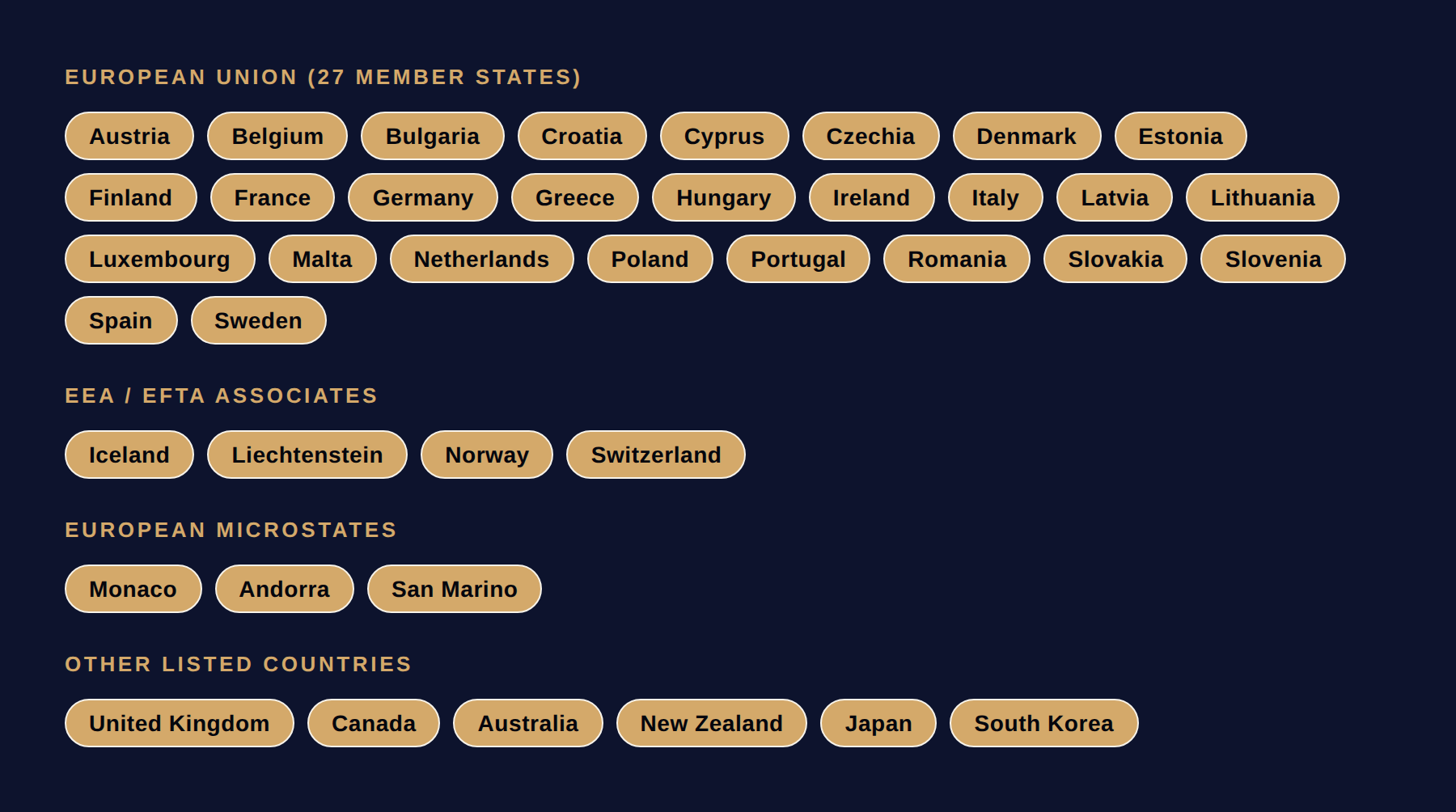
The Board describes these countries as “widely recognized for their extensive human rights protections, democratic values, peaceful transfer of power traditions, fair and effective justice systems, and highly developed economies.” The categorization is based on current conditions and, the Board acknowledges, is subject to change: countries may be added to or removed from the list based on significant governmental changes or other developments impacting individual human rights.
The EU-Internal-Relocation Discretionary Bar
The second main doctrinal move in Matter of B-S-A-N- applies specifically to EU nationals and functions as an additional, independent barrier beyond the general safe-countries presumption. The Board holds that even if an EU national could somehow establish a well-founded fear of persecution in their country of nationality, that national would be presumptively ineligible for a discretionary grant of asylum because they can reside lawfully in any of the other 26 EU member states.
The reasoning draws on the EU’s Directive 2004/38/EC, which gives EU citizens the right to move and reside freely within the territory of EU member states, subject to meeting employment, self-employment, educational, or financial self-sufficiency requirements. The Board treats these requirements as administrative formalities (requirements for registration within three months and obtaining a certificate of residency) rather than as substantive barriers. The Board also notes that after five years, an EU citizen is entitled to permanent resident status in a host EU member state.
The analytical move is doctrinally novel. Internal relocation analysis has historically applied within a single country of nationality: an asylum applicant who could safely relocate within their own country does not have a well-founded fear of persecution. The Board now extends this reasoning supranationally across the EU, treating the entire 27-member bloc as if it were a single internal-relocation universe for asylum purposes.
“EU citizens are presumptively ineligible for a discretionary grant of asylum in the United States because they are entitled to indefinitely reside lawfully in any EU member state.”
MATTER OF B-S-A-N-, SECOND HOLDING
The Board also suggests that this reasoning could extend to other bilateral or multilateral residence agreements affecting non-EU nationals, specifically naming the Mercosur Residence Agreement covering certain South American countries and the Trans-Tasman Travel Arrangement between Australia and New Zealand. This signals that the EU-focused reasoning is the leading edge of a broader analytical framework rather than the final boundary.
The Pretermission Framework at Master Calendar
The procedural piece of the decision gives the safe-countries framework its sharpest practical effect. The Board instructs that pretermission (summary denial without a merits hearing) “will generally be appropriate… typically at the master calendar stage,” citing Matter of H-A-A-V-, 29 I&N Dec. 233 (BIA 2025), which held that it is appropriate for an Immigration Judge to pretermit a respondent’s asylum application when the respondent does not meet the burden to establish prima facie eligibility.
PROCEDURAL CONTEXT
A master calendar hearing is the first procedural hearing in an Immigration Court case, typically used to address preliminary matters (pleadings, continuances, counsel appearances, preliminary motions) before any merits testimony is scheduled. Pretermission at this stage means the case is resolved before the respondent ever testifies about the underlying facts of her claim.
The combination of the safe-countries presumption and master-calendar pretermission produces a procedural pathway in which nationals of the ~40 listed countries will not, in the ordinary course, receive a merits hearing on their asylum, withholding, or CAT claims. The practical consequence is that evidentiary development of these claims (country conditions reports, personal testimony, expert declarations, corroborating documentation) becomes unavailable in most cases because the proceedings never reach the merits stage.
Which ‘Safe Countries’ Aren’t Actually That Safe
The decision’s most legally vulnerable aspect is its categorical treatment of 40 countries despite significant empirical variation among them. The Board describes the entire category as “widely recognized for their extensive human rights protections, democratic values, peaceful transfer of power traditions, fair and effective justice systems, and highly developed economies,” but several of the listed countries have experienced or continue to experience conditions that complicate that characterization.
Hungary. Under Prime Minister Viktor Orban’s Fidesz party, Hungary has experienced significant democratic backsliding over more than a decade. The European Commission has formally identified Hungary as a “hybrid regime” and withheld EU funds based on rule-of-law concerns. Freedom House downgraded Hungary from “free” to “partly free” in 2019, the first EU member state to receive that designation. Independent judiciary, press freedom, and civil society constraints in Hungary are documented in multiple ongoing EU-level proceedings.
Slovakia. Since the return of Prime Minister Robert Fico in 2023, Slovakia has moved sharply toward Hungary-style democratic restrictions, including on press freedom and the independence of public broadcasting. Multiple European observers have raised concerns about rule-of-law deterioration.
Poland. Prior to the October 2023 government change, Poland experienced a sustained period of judicial-independence concerns under the Law and Justice party, culminating in European Court of Justice rulings against Polish judicial reforms. While conditions have improved under the current government, the recent historical record documents a European Union member state experiencing serious rule-of-law backsliding.
Romania and Bulgaria. Both countries have documented ongoing issues with persecution of Roma communities, which has given rise to legitimate asylum claims. The Ninth Circuit’s Lapadat v. Bondi decision (2025) addressed exactly this issue in the Romanian context, applying “disfavored group” analysis to recognize that Roma asylum seekers from Romania may face sufficient individualized risk of persecution. Matter of B-S-A-N- expressly rejects that framework.
EU-level LGBTQ+ concerns. Multiple EU member states, including Hungary, Poland (particularly historically), and various others, have implemented or attempted to implement anti-LGBTQ+ measures that have drawn formal EU proceedings. For LGBTQ+ asylum seekers from these countries, the categorical “safe country” designation forecloses analysis of risks specific to their identity group.
The Board acknowledges a general escape valve, noting that country conditions evidence in individual cases “may warrant adding or removing countries from the category of safe countries.” In practice, however, the combined effect of a strong presumption of safety plus master-calendar pretermission means that the evidentiary development needed to overcome the presumption may not occur in the ordinary course of proceedings. The procedural framework and the substantive presumption reinforce each other.
The decision does not engage specifically with the democratic-backsliding evidence described above. For practitioners representing clients from affected countries, developing a record that engages this empirical variation is now a central strategic task.
Note for Practitioners in the Ninth Circuit
The decision openly rejects the Ninth Circuit’s 2025 decision in Lapadat v. Bondi, 145 F.4th 942 (9th Cir. 2025), which had applied “disfavored group” analysis to Roma asylum applicants from Romania. The Board sides with the First, Third, Seventh, and Eleventh Circuits, which have rejected the Ninth Circuit’s framework. This creates an immediate and clean conflict between the BIA and the Ninth Circuit that will produce circuit-level litigation.
For attorneys handling cases that will be reviewed in the Ninth Circuit, Lapadat remains binding circuit precedent on petition for review. The BIA will apply Matter of B-S-A-N- at the agency level, which means Ninth Circuit respondents from EU countries (particularly Romania and other EU member states with disfavored-group analysis implications) should expect pretermission at the master calendar stage and should preserve all issues for the petition for review stage where Lapadat can be invoked.
UNITED STATES COURT OF APPEALS FOR THE NINTH CIRCUIT
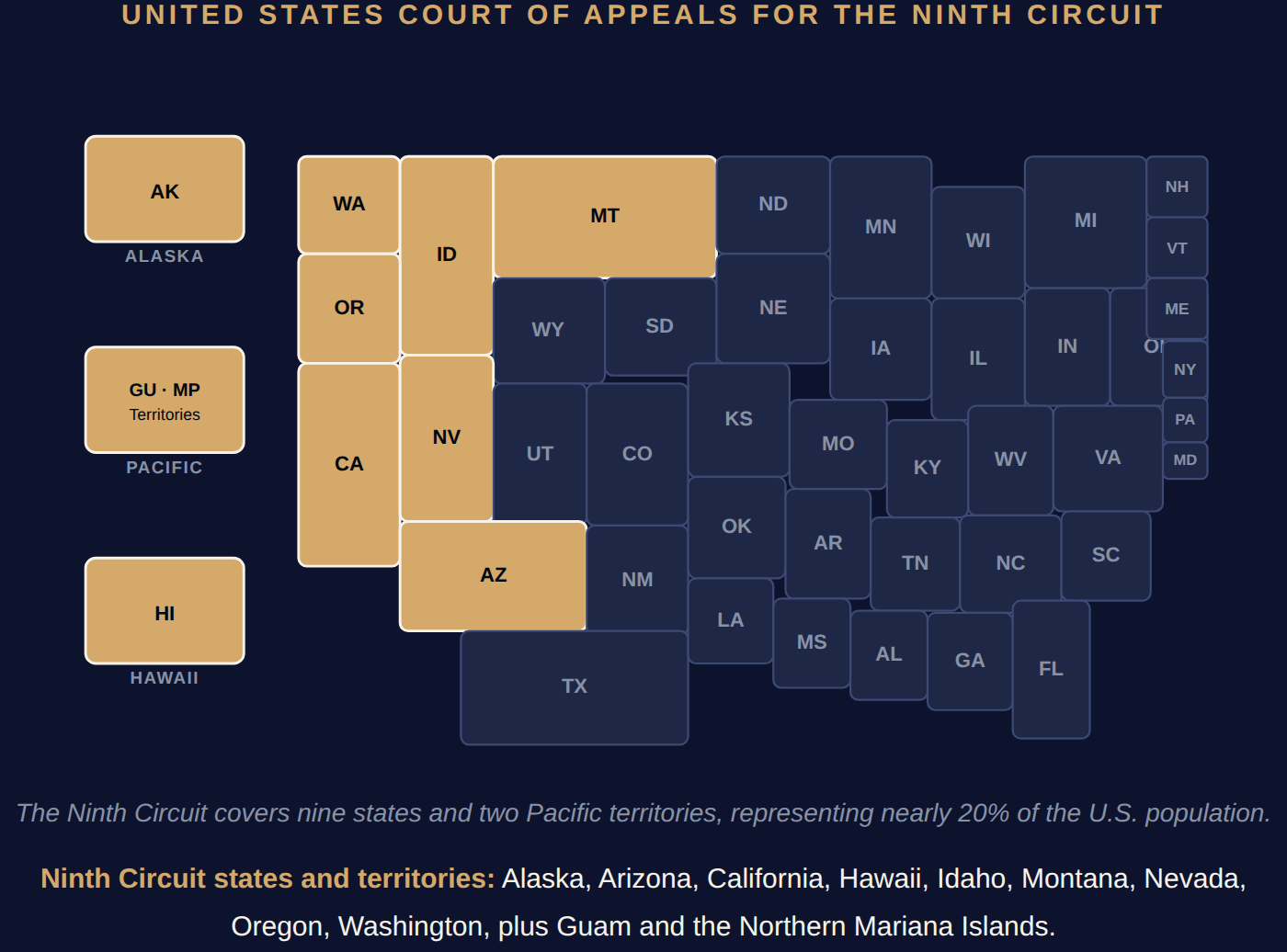
The Ninth Circuit covers nine states and two Pacific territories, representing nearly 20% of the U.S. population.
Ninth Circuit states and territories: Alaska, Arizona, California, Hawaii, Idaho, Montana, Nevada, Oregon, Washington, plus Guam and the Northern Mariana Islands.
For practitioners outside the Ninth Circuit, Matter of B-S-A-N- is binding at the agency level and will govern the outcome at Immigration Court and the BIA. Petitions for review in other circuits will face a different posture than those filed in the Ninth Circuit, because the First, Third, Seventh, and Eleventh Circuits have aligned with the BIA’s rejection of the disfavored-group framework. Attorneys in those circuits should treat Matter of B-S-A-N- as effectively binding on the discretionary and categorical questions it decides.
For practitioners in the Ninth Circuit specifically, the strategic path forward involves (1) preserving every available argument before the Immigration Judge and the BIA to maintain the record for petition for review, (2) developing country-conditions evidence that engages the categorical “safe country” characterization directly for the specific country at issue, (3) framing claims under Lapadat’s disfavored-group analysis where applicable, and (4) planning for petition for review litigation as the realistic venue for relief.
What This Means for Attorneys Handling Asylum Cases
For immigration attorneys handling asylum, withholding of removal, and CAT cases, Matter of B-S-A-N- changes the strategic posture of any case involving a national of one of the ~40 listed countries. Several practical points follow.
Nationality screening at intake becomes a threshold strategic question, because if a prospective client is a citizen of any country on the list, including dual nationals who hold citizenship in one or more listed countries, the case now faces a presumptive bar that did not exist before this decision. The intake conversation should include a clear discussion of the presumption and of what evidence would be needed to overcome it.
Build country-conditions records that engage the categorical characterization directly. Where the client’s country of nationality is on the list but has documented democratic backsliding, Roma persecution concerns, LGBTQ+ constraints, or other issues that complicate the categorical “safe country” designation, the record should include expert declarations, State Department reports, European Court of Human Rights decisions, European Commission infringement proceedings, Freedom House assessments, and other objective documentation of the specific conditions the client fears.
Prepare for master-calendar pretermission and litigate the procedural question aggressively. The decision contemplates pretermission at master calendar before any merits testimony. Attorneys should request written briefing, submit the strongest documentary record possible before the master calendar hearing, and preserve all objections to pretermission on due process grounds.
For EU national clients, develop evidence addressing the specific internal-relocation presumption. The Board treats EU internal relocation as administrative formality, but the actual requirements (employment, self-employment, educational enrollment with health insurance and financial self-sufficiency) are substantive and may not be feasible for a particular client. Documenting why relocation to another EU state would not be feasible in the client’s specific case is now central to overcoming the second holding.
Preserve the record for federal court review carefully. The decision creates immediate issues ripe for petition-for-review litigation, particularly in the Ninth Circuit where it conflicts with Lapadat. Every issue preserved at the Immigration Judge and BIA levels is an issue that can be raised in the federal circuit court. Issues not preserved are generally not reviewable.
What This Means for Potential Asylum Applicants and Their Families
For individuals from the ~40 listed countries who are considering seeking asylum in the United States, and for family members in the U.S. supporting them, Matter of B-S-A-N- fundamentally changes what to expect from the process.
If you are a citizen of one of the listed countries and you are considering an asylum application, consult with an experienced immigration attorney before filing. The attorney can assess whether your specific circumstances might overcome the categorical presumption and whether there are other immigration options that may be more realistic.
If you hold dual nationality and only one of your two nationalities is on the list, the dual-nationality analysis under Matter of B-R- and this decision becomes central to your case. You will need to establish fear in each country of nationality separately, and your citizenship in a “safe country” will make that showing substantially harder.
If you are already in removal proceedings with a pending asylum application and you are a national of a listed country, speak with your attorney about how this decision affects your case. Depending on the stage of proceedings, additional record development or specific strategic adjustments may be needed.
If you are an LGBTQ+ individual, a Roma individual, or a member of another specific group facing documented risks in a listed country, your case may be able to overcome the categorical presumption through group-specific evidence, but the showing is now substantially more demanding than it was before this decision.
What Matter of B-S-A-N- Does Not Change
The decision creates sweeping new barriers but has limits worth stating clearly.
The decision does not categorically bar asylum from the listed countries. The Board characterizes its holding as creating a presumption that may be overcome in “extraordinary circumstances involving national security or foreign policy considerations.” How broadly that exception operates in practice remains to be litigated.
The decision does not change the statutory definition of refugee under INA § 101(a)(42) or the substantive standards for asylum, withholding, or CAT protection. The decision operates on the procedural and discretionary dimensions rather than redefining the underlying substantive law.
The decision does not foreclose petitions for review at federal courts of appeals. The listed countries presumption and the pretermission framework will both be litigated in federal court, and the Ninth Circuit split signals that circuit-level outcomes will vary.
The decision does not reach other forms of immigration relief. Cancellation of removal, adjustment of status, U-visas, T-visas, VAWA self-petitions, and other forms of relief operate under their own frameworks and are not directly affected by Matter of B-S-A-N-.
The decision does not address removal to third countries. The decision addresses only asylum, withholding, and CAT applications. Removal to a country other than the applicant’s country of nationality operates under separate frameworks.
Frequently Asked Questions
What is pretermission at master calendar?
Pretermission is a procedural device by which the Immigration Judge summarily denies an application without a merits hearing. Master calendar is the first procedural hearing in a case. Pretermission at master calendar means the Immigration Judge decides the application without ever hearing the respondent testify about the underlying facts of her claim, based solely on legal grounds (such as the categorical presumption that nationals of certain countries do not qualify for asylum).
Can an EU national ever get asylum under Matter of B-S-A-N-?
Yes, in principle. The Board states that the presumption against EU nationals may be overcome “based on national security or foreign policy considerations.” How broadly that exception operates in practice has not been developed yet. Additionally, country conditions evidence showing a specific country should be removed from the safe list may support an exception.
What is “disfavored group” analysis under Lapadat?
Disfavored-group analysis is a framework developed by the Ninth Circuit for asylum cases where the applicant is a member of a disfavored group (such as Roma in some European countries) and faces a sufficient individualized risk of persecution based on that group membership. Lapadat v. Bondi, 145 F.4th 942 (9th Cir. 2025), applied this analysis to a Romanian Roma applicant and found that the BIA likely erred in determining there was insufficient individualized risk. Matter of B-S-A-N- expressly rejects this framework.
Which countries are affected by this decision?
Approximately 40 countries: all 27 EU member states, Iceland, Liechtenstein, Norway, Switzerland, Monaco, Andorra, San Marino, the United Kingdom, Canada, Australia, New Zealand, Japan, and South Korea.
Does the decision affect existing pending cases?
Yes. The decision applies prospectively to all cases pending at the agency level that have not yet reached a final decision. Attorneys with existing cases should review the impact on their clients’ cases immediately.
Can an attorney challenge this decision?
Yes. The decision is subject to petition for review at the federal court of appeals in the circuit where the case arose. The Ninth Circuit, which has already decided Lapadat on a related issue, is likely to produce early appellate review. Other circuits that have rejected the disfavored-group framework may be more receptive to the Board’s reasoning.
Where can I find Matter of B-S-A-N-?
Matter of B-S-A-N-, 30 I&N Dec. 145 (BIA 2026), Interim Decision #4259, is a precedent decision of the Board of Immigration Appeals decided October 9, 2026. It is available through the Department of Justice Executive Office for Immigration Review website.
Why Novo Legal
Novo Legal Group is a bilingual, community-rooted human rights firm. Every attorney on our team is fluent in English and Spanish. Our litigation team handles asylum, withholding of removal, and Convention Against Torture applications, appeals to the Board of Immigration Appeals, and petitions for review before federal courts of appeals including the Ninth and Tenth Circuits. We follow precedent developments in real time and build our client representation around the current doctrinal framework, which has shifted substantially over the past two months. If you or a family member is a national of a listed country considering asylum, or already in proceedings with a pending claim, contact us. We will tell you what we would do given your specific facts.
SCHEDULE A CONSULTATION
(888) 746-5245 | novo-legal.com/contact