
Advance Parole Just Changed: What Delcarmen-Lara Means for DACA Recipients and Mixed-Status Families
Aaron Elinoff
A new BIA decision changes the rules for advance parole travel going forward. If your trip is already done, the ruling is prospective — here’s what it does and doesn’t mean for you.
Introduction
If you already traveled on advance parole and came back before today, take a breath. The decision we’re writing about is meant to apply going forward, not backward — the Board said so expressly. Based on the ruling as written, a trip you completed before August 13, 2026 should still be governed by the old rule, not the new one.
That is the most important thing an anxious reader can hear right now, so we’re saying it first. Here’s the honest caveat that goes with it: the government has not yet said exactly how it will draw the line — by the date you left, the date you came back, or the date your green-card case is decided. So if you have a pending case and any advance-parole travel in your history, this is a moment to get a case-specific answer from an attorney, not to guess.
Already traveled and want a real answer before you lose sleep over it? Talk to us. Our intake team answers bilingually.
Schedule a consultationToday, the Board of Immigration Appeals overruled a rule that immigration lawyers and families have relied on for 14 years. This post explains what happened, who is and isn’t affected, what it means mechanically for a green-card case, what nobody knows yet, and what to do now.
What happened
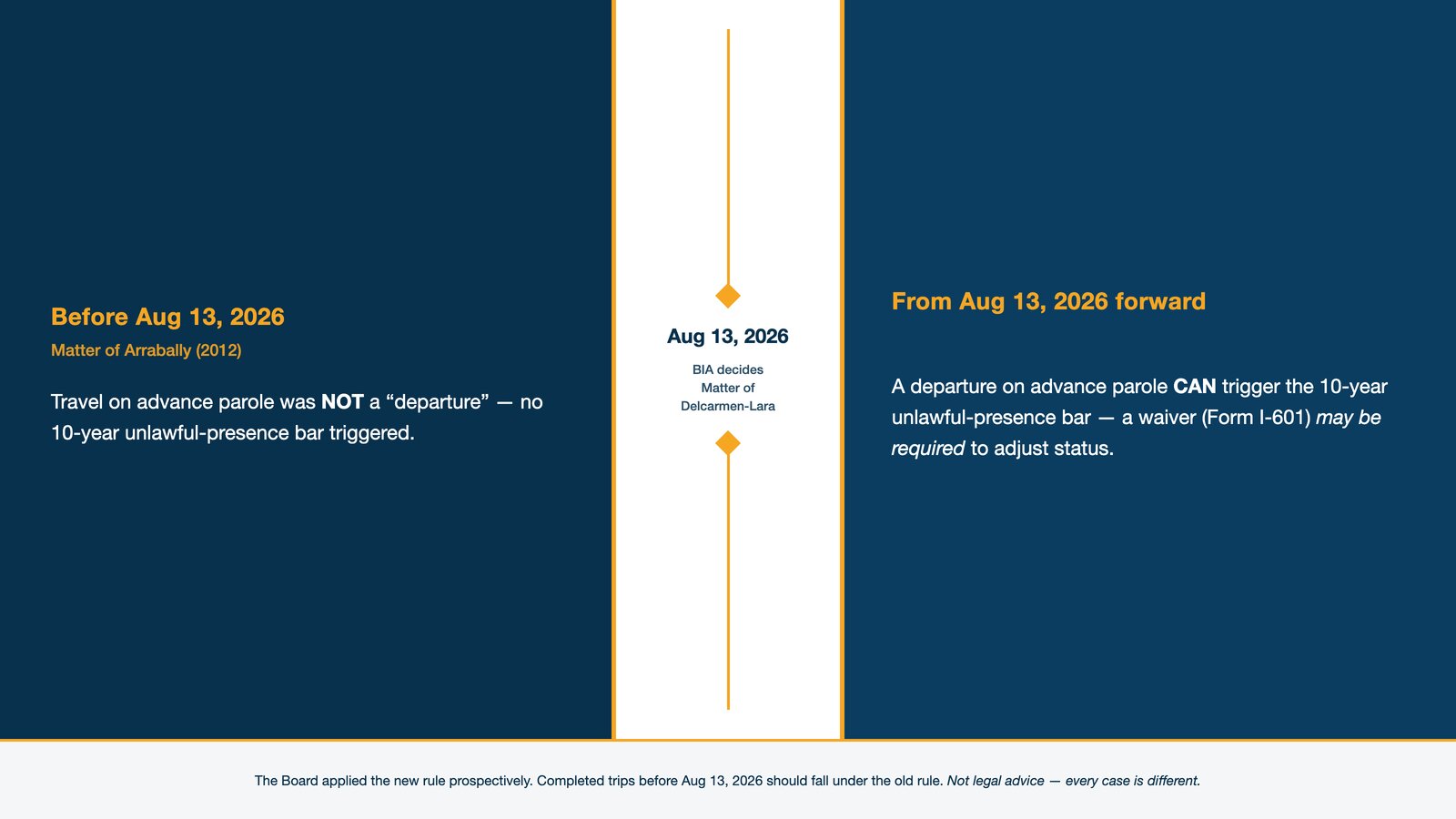
The Board of Immigration Appeals — the highest administrative court in the immigration system — issued a decision called Matter of Delcarmen-Lara, 29 I&N Dec. 830 (BIA 2026), decided August 13, 2026. In it, the Board overruled a 2012 decision, Matter of Arrabally and Yerrabelly, 25 I&N Dec. 771 (BIA 2012).
Here is the change in one sentence: leaving the United States on advance parole now counts as a “departure” for purposes of the unlawful-presence bar.
That may sound technical, so here’s why it matters. The Board reasoned in plain language — it looked up the ordinary meaning of the word “depart,” which the dictionary defines as “to go away: leave,” and found nothing in the statute that carves out a trip taken on advance parole. Under the old Arrabally rule, a trip on advance parole was treated as not a departure, so it did not trigger the bar. That treatment is what the Board just threw out.
The strategy this affects
For years, a common and lawful path looked like this: a person who was in the U.S. without status — very often a DACA recipient married to a U.S. citizen — would get advance parole, travel abroad briefly, and be paroled back in at the airport. That parole gave them a “lawful entry,” which is one of the things you generally need to apply for a green card from inside the country under Section 245(a) adjustment of status. It let people fix their status without leaving the country for a risky consular trip abroad.
Delcarmen-Lara changes the calculation for that route going forward. The departure that used to be harmless can now, on its own, create a problem that surfaces later in the green-card case.
Who is NOT affected (read this first if you already traveled)
Your advance-parole trip is already completed
The Board applied its new rule prospectively — meaning going forward, not to trips already taken. It specifically declined to decide whether the person in this very case, whose trip happened before the ruling, had made a “departure.” So a completed trip should still fall under the old Arrabally rule. The honest caveat, again: the government hasn’t spelled out exactly where it will draw the line, so a pending case with prior travel deserves a real review — see “What we don’t know yet” below.
You never accrued enough unlawful presence to trigger the bar
The bar only applies to people who built up a certain amount of “unlawful presence” before leaving. And unlawful presence is not the same as simply being here without status. Two rules matter for a lot of our clients: time before you turned 18 does not count, and time while a DACA grant is in effect does not count. But an initial DACA request generally does not stop unlawful-presence accrual while it is pending for someone already 18, and gaps between DACA periods may also count. Many DACA recipients got DACA young enough that they never accumulated the year of unlawful presence that triggers the 10-year bar in the first place. Whether that’s true for you is exactly the kind of thing an attorney checks case by case — it is not a do-it-yourself calculation.
Your trip was not on advance parole
Delcarmen-Lara specifically changes the treatment of advance-parole departures. It does not create a new rule for travel using a visa or another travel document. But a visa is not the same as lawful status, and existing unlawful-presence and inadmissibility rules may still apply.
Who IS affected
Anyone with a year or more of unlawful presence weighing advance-parole travel now
If you accrued one year or more of unlawful presence and you’re thinking about traveling on advance parole from today forward, this decision is squarely about you. Under the statute, a person who has been “unlawfully present in the United States for one year or more, and who again seeks admission within 10 years of the date of such alien’s departure or removal from the United States, is inadmissible.” The new rule means the advance-parole trip can be the “departure” that starts that clock.
DACA recipients married to U.S. citizens planning the parole-entry route
This is the group the old strategy was built for, and it’s the group most affected going forward. If your plan was to get advance parole, travel, come back with a lawful entry, and then adjust status through your U.S.-citizen spouse, that plan now needs a fresh look before you book anything. Many DACA recipients fit exactly this profile.
Pending green-card applicants holding an advance-parole card, and humanitarian parolees with prior unlawful presence
If you have a pending adjustment case and an approved advance-parole (Form I-131) card in hand, or you’re a humanitarian parolee who had unlawful presence before your current status, a future advance-parole trip carries a risk it didn’t carry last week. Don’t treat an approved travel card as a green light on its own.
People with an old removal order
If you have a prior order of removal, advance-parole travel has always carried separate and more serious risks, and this is never a do-it-yourself situation — talk to an attorney before you go anywhere.
What it means mechanically
Let’s be concrete about how this actually plays out, because the mechanics are what calm people down or scare them for the wrong reasons.
Return at the airport is not guaranteed. Many travelers with valid advance parole are paroled back into the United States, but the document does not guarantee parole. On return, the traveler remains an applicant for admission and is inspected by CBP. Delcarmen-Lara can create an inadmissibility issue because the trip is now treated as a departure; that issue may matter at the port of entry and again when USCIS decides adjustment of status.
A Form I-601 waiver may be available. An eligible applicant adjusting status inside the U.S. may be able to request a discretionary waiver under INA § 212(a)(9)(B)(v) on Form I-601. Eligibility and approval are not automatic. Two things surprise people about it, and both matter:
- Not everyone in your family “counts.” The waiver requires showing extreme hardship to a U.S.-citizen or lawful-permanent-resident spouse or parent — and only a spouse or parent. A U.S.-citizen child does not count as a qualifying relative for this waiver. Families are often shocked by that.
- “Extreme hardship” is a real standard. You have to actually prove that denying the case would cause extreme hardship to that qualifying relative — it’s a specific, evidence-heavy showing, not a box to check.
If you want to understand how that waiver works in practice, we’ve written a plain-language guide to the I-601 unlawful-presence waiver that walks through the extreme-hardship standard and the qualifying-relative rule.
What we don’t know yet
We’re going to be straight about the open questions, because a rapid-response post that pretends everything is settled isn’t doing you any favors.
The government hasn’t issued guidance yet. A BIA decision binds the Department of Homeland Security, including USCIS — that’s the general rule even before USCIS publishes its own instructions. But exactly how USCIS will operationalize the prospective line — whether it keys off the date you departed, the date you returned, or the date it decides your case — is not yet known. That’s the single biggest reason a pending case deserves individual review right now.
Courts may weigh in. The Board noted that the federal appeals court covering this case had previously followed the old Arrabally rule, and said that didn’t stop it from adopting the new reading. Whether other federal courts around the country will agree is an open question — not something we’re going to predict.
The three-year bar is not part of the holding. This decision names only the 10-year bar, which applies after one year or more of unlawful presence. There is a separate three-year bar for shorter periods of unlawful presence. The Board’s reasoning — that a departure is a departure — would likely reach the three-year bar the same way, so it would be prudent to treat a shorter period of unlawful presence as carrying similar risk. But the Board did not decide that here, so it is not settled law.
TPS travel may be a different situation. Since around July 2022, people with Temporary Protected Status who travel have generally been issued a “travel authorization” under a law called MTINA — documented on Form I-512T — rather than advance parole. This decision is specifically about advance-parole departures, and it doesn’t mention MTINA travel authorization at all. That gives rise to an argument that TPS travel under I-512T falls outside this ruling. We want to be careful here: that is an argument, not a settled answer, and anyone with TPS considering travel should get a case-specific read before relying on it.
What to do now
The takeaways are short.
- Don’t book advance-parole travel without a case-specific review. The whole point of this ruling is that a trip can have consequences it didn’t have last week — and whether those consequences reach you depends on your specific history.
- If you already traveled, don’t panic. The ruling is prospective, and a completed trip should still fall under the old rule. Get advice if you have a pending case, but this is not a five-alarm fire for a trip that’s already behind you.
- Whether the bar even applies to you is a case-by-case question. Because unlawful presence depends on your age, your DACA history, and your specific timeline, two people who took the same trip can be in completely different positions. That’s why a real review beats anything you read on the internet — including this post.
Get a real answer before you book anything.
Novo Legal Group is a Spanish-first immigration practice — every attorney and staff member is bilingual. If you’ve traveled on advance parole, or you’re weighing a trip, we’ll look at your actual timeline and tell you where you stand. Not a form to fill out and forget — a real conversation about your case.
Schedule a consultationOr call us at (888) 746-5245.
Why Novo Legal
Advance parole and adjustment of status are exactly the kind of interlocking questions where one wrong assumption costs a family years. We handle immigration full-time, we read the decisions the day they come out, and we serve a heavily Spanish-speaking community that this ruling hits hardest. When a rule changes overnight, our clients get a straight answer about what it means for their case — not generic reassurance and not fear. That’s the job.
Related reading
- Adjustment of status without leaving the U.S. (Section 245(a)) — how the green-card-from-inside-the-country route works, and where advance parole fits in.
- The I-601 unlawful-presence waiver, explained — the extreme-hardship standard and the spouse-or-parent qualifying-relative rule.
- DACA renewal timeline 2026 — what the current DACA landscape looks like right now.
- Read the decision itself: Matter of Delcarmen-Lara, 29 I&N Dec. 830 (BIA 2026) — the full BIA opinion (PDF).
Frequently asked questions
Did I trigger a 10-year bar by traveling on advance parole before today?
Probably not. The August 13, 2026 decision applies going forward, and based on the ruling as written a trip you completed before that date should still fall under the older rule. The government hasn’t spelled out exactly how it will draw the line, so if you have a pending case, get it reviewed — but a completed trip is not the emergency the internet may be telling you it is.
Does this mean I’ll be turned away at the airport when I come back?
Not automatically. A valid advance-parole document does not guarantee that CBP will parole you into the United States. On return, you remain an applicant for admission and are inspected by CBP. Delcarmen-Lara can create an inadmissibility issue because the trip is now treated as a departure, and that issue may matter at the port of entry and again when USCIS decides adjustment of status.
I have DACA. Am I automatically caught by this?
Not automatically. The bar only applies if you built up enough unlawful presence to trigger it — and time before you turned 18 and time while your DACA is in effect generally don’t count toward it. But an initial DACA request generally does not stop accrual while it is pending for someone already 18, and gaps between DACA periods may also count. Many DACA recipients never accrued the year of unlawful presence the 10-year bar requires. Whether that’s true for you depends on your specific timeline, which is exactly why this is a consultation question, not a self-diagnosis.
Is the three-year bar triggered too?
The decision names only the 10-year bar. The Board’s reasoning would likely reach the three-year bar the same way, so it is prudent not to assume a shorter period of unlawful presence is safe — but the Board did not decide that here, so it isn’t settled.
What if I still need to travel? Is there any way to fix a green-card case after a trip?
Possibly — the unlawful-presence bar can be waived at adjustment of status through a Form I-601 waiver, if you can show extreme hardship to a U.S.-citizen or lawful-permanent-resident spouse or parent. It’s a demanding, evidence-heavy showing, and a U.S.-citizen child doesn’t count as the qualifying relative. This is a plan to build with an attorney before you travel, not after.